3
min read
Fifty accessibility errors
That's how many accessibility errors the average B2B SaaS website has — per page. Most teams don't know because nobody owns the problem.

Sofya Leonova
Co-founder + Marketing Director
When we audit a B2B SaaS website, we check the obvious things first — messaging clarity, competitive positioning, the ten-second test. But there's a category of issues we find on almost every site that rarely comes up in the brand conversation: accessibility.
And honestly, the numbers are kind of staggering. The average website among the top million sites has over fifty accessibility errors per page. Not edge cases. Not obscure technical failures. Simple things — low-contrast text that's hard to read, missing alt text on images, buttons that can't be reached with a keyboard.
One in four website visitors has some form of accessibility need. In a B2B context — where your website is often the first real interaction a prospect has with your company — these errors aren't just usability problems. They're trust problems.
Why this is a brand quality signal
When a prospect evaluates a B2B SaaS company, they're pattern-matching for quality. They check the product, obviously. But they also check the website, the docs, the onboarding flow. They're looking for signals that this company pays attention to detail — that they build things with care.
A website full of accessibility errors sends the opposite signal. It says: we shipped this without thinking about who would actually use it.
For a company selling software — a product whose entire value depends on being well-built and thoughtful — that's a costly message to send. Even if the prospect never consciously notices a missing alt tag, the cumulative impression of a sloppy site sticks.
In our experience, the B2B companies that get accessibility right tend to be the same companies that get messaging, structure, and conversion right. It's not a coincidence. Accessibility and good design are the same discipline. They both require thinking carefully about how real people interact with what you've built.
Five things worth fixing first
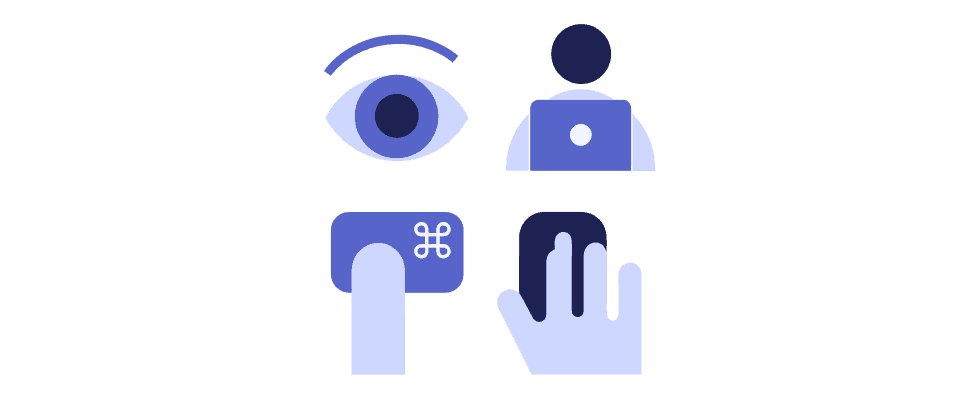
Most accessibility problems on B2B SaaS websites fall into five categories. None of them require a redesign. All of them make the site better for every visitor — not just those using assistive technology.
Alt text for images. When a screen reader hits an image without alt text, the visitor gets nothing — or worse, a filename like "hero-banner-final-v3.png." Every image should have descriptive alt text that communicates what it is and why it's there. This is also an SEO fundamental — search engines read alt text to understand your content. Two birds, one fix.
Focus states for interactive elements. When someone navigates your site with a keyboard — which is common for users with motor disabilities, but also for power users and anyone whose trackpad just died — they need visible indicators on buttons, links, and form fields. A clear border or highlight that shows where they "are" on the page. Without it, keyboard navigation is guesswork.
Keyboard navigation, period. Every button, link, and form field on your site should be reachable and usable via keyboard alone. Tab through the page in a logical order, activate things with enter or space. If your site requires a mouse to function, you've quietly excluded a meaningful chunk of your visitors.
Heading hierarchy. The heading tags on your page — H1, H2, H3 — define the logical structure of your content. Screen readers rely on this to help users navigate. Skipping levels (jumping from H1 to H3, say) breaks the structure and makes the page harder to parse. Clean heading hierarchy also improves SEO and readability for everyone. It's one of those things that's free to get right and expensive to get wrong.
Color contrast. The contrast ratio between your text and background determines whether your content is actually readable. WCAG recommends 4.5:1 for normal text, 3:1 for large text. A lot of B2B websites fail this — especially the ones using light gray text on white backgrounds. It looks clean in Figma. It becomes a readability problem on any screen with ambient light.
Why nobody fixes this
The reason these errors persist is simple: nobody owns the problem.
Designers make choices in tools that don't flag contrast issues. Developers implement what they receive without adding alt text or focus states. Product managers don't include accessibility in requirements. And the CEO or VP of Marketing reviewing the site? They're checking messaging and aesthetics — not keyboard navigation.
The fix isn't to hire an accessibility consultant after the site is built. It's to make accessibility part of how the team builds from the start. When your designer checks contrast ratios as they choose colors — not after launch — the cost of getting it right drops to nearly zero. When your developer writes semantic HTML with proper heading structure as the default — not as a retrofit — it's actually faster, not slower.
The best companies treat accessibility like responsive design. Not a separate workstream. A baseline expectation.
The business case nobody talks about
Beyond the ethical argument — which should be reason enough — accessibility directly affects the metrics companies care about.
SEO rankings improve because search engines reward semantic HTML, proper headings, descriptive alt text, and logical page structure. These are all accessibility fundamentals.
Conversion rates improve because accessible sites are easier for everyone to use. Clear focus states, readable text, logical navigation — these reduce friction for all visitors, not just those with assistive tech.
Enterprise sales get easier because large companies increasingly include accessibility compliance in vendor evaluations. A site that meets WCAG standards is one less objection in procurement.
And brand perception improves because accessibility signals care and attention to detail — exactly what a B2B prospect is looking for in a software partner.
A quick audit
Open your website in Chrome. Right-click, select "Inspect," go to the Lighthouse tab, and run an accessibility audit. Most B2B SaaS websites score between 60 and 80 out of 100.
If yours is below 80, the good news is that the highest-impact fixes are also the simplest. And every fix makes your site better for everyone — not just the visitors your analytics can see.