4
min read
"Good enough" is the most expensive quality bar
Most B2B SaaS companies set the quality bar at 'good enough' because nobody's pushing for more. That gap is your opportunity.

Sofya Leonova
Co-founder + Marketing Director
Here's something that's always puzzled me about B2B marketing: the quality bar is dramatically lower than in consumer marketing.
Consumer brands invest heavily in how their marketing looks, reads, and feels. The design is considered. The copy is sharp. The production value signals that someone cared. But in B2B — even in software, where the teams are technical and the products are sophisticated — the marketing often looks like nobody really cares all that much. Generic stock photography. Copy that reads like it was written in a hurry, or worse yet, with AI. Landing pages that feel like templates because they are templates.
The usual explanation is that B2B buyers are "rational" — they make decisions based on features and ROI, not feelings. I fundamentally disagree with that. B2B buyers are still people. They represent the companies they work at, but they have opinions and instincts and taste. They notice when a website feels polished and when it feels like an afterthought. They notice when an email is well-written and when it's AI generated.
People want to feel good about the companies they spend money on. That doesn't change when the purchase order has a company name on it instead of a personal credit card. And whether they articulate it or not, the quality of your marketing shapes their perception of the quality of your product.
That gap between B2B's low bar and what's actually possible is one of the cheapest competitive advantages available to an early-stage SaaS company.
What quality actually signals
When a prospect encounters your marketing, they're forming an impression of your company before they ever talk to sales. That impression is built from a hundred small signals: the tightness of the copy, the consistency of the visual identity, the production value of a webinar, the thoughtfulness of your email sequence.
High quality across those touchpoints signals credibility. If your marketing is polished, prospects assume your product is polished. If your emails are well-written, they assume your team is competent. If your brand is consistent, they assume your company is organized. These aren't conscious evaluations — they're pattern matches that happen automatically.
The reverse is also true. Typos in an email. A blog post that reads like filler. A webinar with bad audio and a slide deck that looks like it was thrown together the morning of. Each one is a small signal that nobody is paying close attention. And if nobody's paying attention to the marketing, a prospect reasonably wonders: are they paying attention to the product?
Quality also makes you easier to refer. When someone forwards your article to a colleague, your brand goes with it. If the article is thoughtful and well-produced, the referral feels good — the person who shared it looks smart for finding it. If it's mediocre, the referral reflects poorly on them, and they might choose not to share it at all.

What a high quality bar actually requires
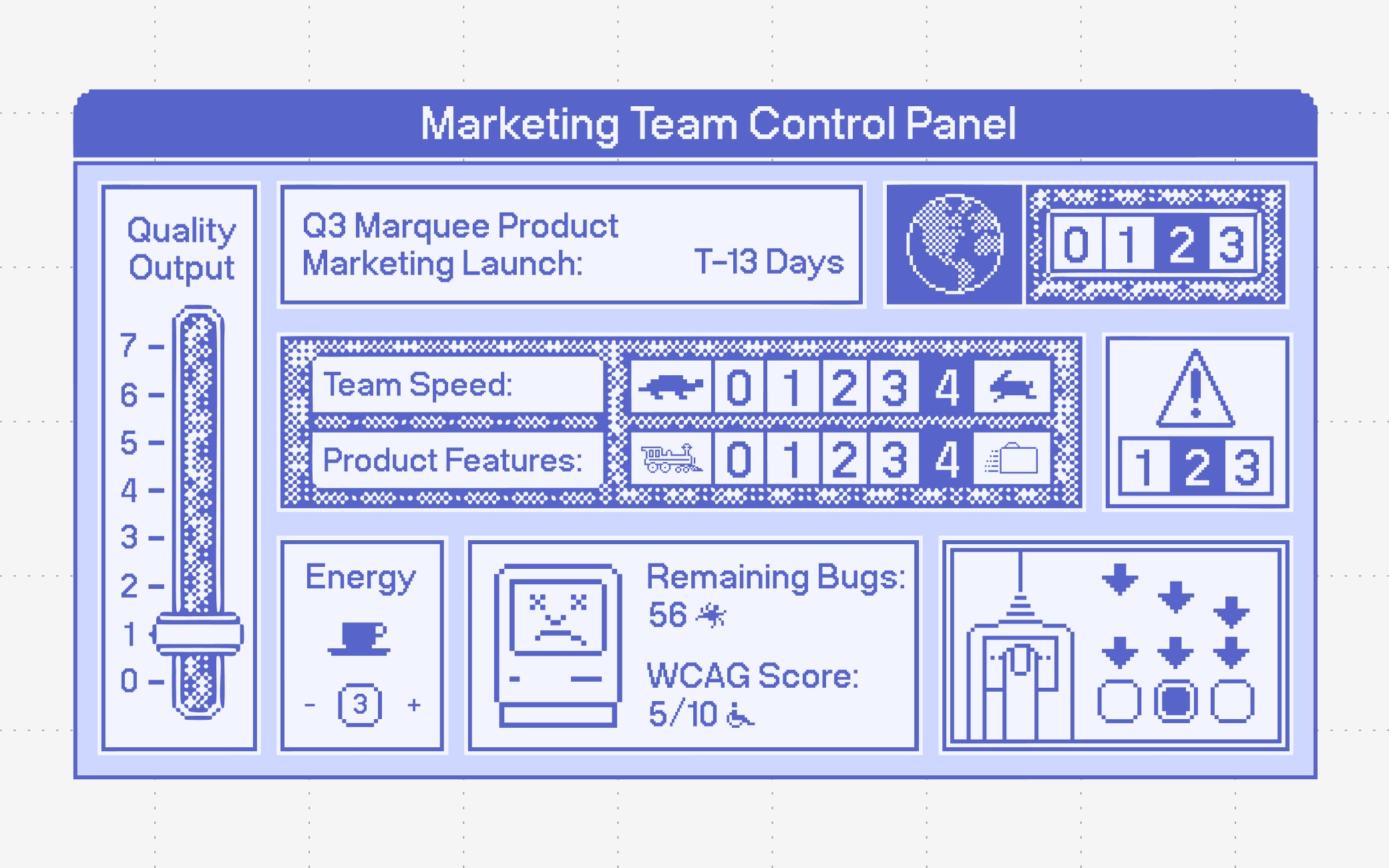
This isn't about budget. Some of the best B2B marketing we've seen came from small teams with limited resources. What it requires is a leader who builds a culture that refuses to let things ship at "good enough."
Even on a four-person marketing team I was a part of, every piece of content went through reviews with at least two other members of the team. A blog post would be drafted, reviewed by a senior team member who'd improve it and give feedback, then reviewed by the VP of Marketing who'd make final adjustments. Emails, landing pages, social copy — all of it went through the same process. The event marketer would sometimes review copy that had nothing to do with events, because she was a strong writer and another perspective made the work better.
It never felt like a bottleneck. Because the system was designed for it. Reviewers had two business days to turn things around. Every project had a timeline with specific deadlines for each step, tracked in a project management tool. People logged in each morning, saw what they needed to review that day, and were accountable for it. The project plans accounted for review time upfront — nothing was scheduled so tightly that quality had to be sacrificed for speed.
The key was lead time. Nothing was done last minute. When things are last minute, quality drops — it's almost a law. The team knew exactly how long every type of project took, when each phase needed to start, and what the dependencies were. Reports took three months. Customer features took six to eight weeks. Blog posts took two weeks. And those timelines created space for the work to be good, not just done.
Where the gap shows up most
Copy is usually the first place you notice a quality gap. Lazy copy is easy to spot: it's salesy without being specific, or fluffy without saying anything useful. It uses buzzwords instead of concrete descriptions. It tells you something is "powerful" or "seamless" instead of showing you what it actually does.
Design consistency is the second. Your website, your emails, your slide decks, your social posts, your reports — they should look like they came from the same company. Not identical, but unmistakably related. The details — type size, color use, stroke weights — either add up to a cohesive identity across touchpoints or slowly unravel the visual identity one asset at a time. When the visual identity drifts, it signals that nobody's maintaining the standard.
Project management is the third. When things slip, get rushed, or ship without review, the output suffers. And sooner or later the team burns out.

The maintenance problem
The hardest part of a high quality bar isn't reaching it. It's maintaining it. We see this with our clients. A company invests in getting their brand right — positioning, messaging, visual identity, website — and it looks great on launch day. Six months later, new pages have been added without following the design system. Blog posts are going up without the same editorial rigor. The sales team created their own slide deck. The quality erodes incrementally, and nobody notices until the brand feels inconsistent again. (This is why we launched Proof Positive.) All in the name of speed. "Move fast and break things," am I right?
Maintaining the bar requires someone who owns it and sets the standard. They have to care. They have to have the authority to send things back. And they have to set the standard by example. Without that person, the work slowly drifts toward entropy.
This has to come from the top, or at least be supported from the top. A junior marketer who cares about quality but reports to someone who doesn't will burn out. A VP who sets the bar and holds people to it creates a culture where quality is the expectation, not the exception.
The opportunity
Because most B2B SaaS companies set their quality bar at "good enough," the opportunity for a company that sets it higher is significant. You don't have to be twice as good. You have to be noticeably better. And in a market where the baseline is mediocre, noticeably better is more achievable than most founders think.
It starts with one person deciding that the work should be better than it needs to be. Not perfect. Better. And then building the process — the review cycles, the timelines, the accountability — that makes it sustainable.