4
min read
What happens when you start a rebrand with a moodboard
You showed up to the brand kickoff with Linear on your inspiration board. So did every other competitor in your category.

Dinesh Davé
Co-founder + Creative Director
We see the same thing at the start of almost every engagement. The marketing team comes to the brand kickoff with a moodboard — and it's full of the same five companies. Linear. Stripe. Notion. Sometimes Arc or Vercel.
The request is always some version of: "We want to look like this."
And we get it. These brands are beautiful. They feel premium, intentional, focused. Of course you want that feeling for your product. The problem is — so does every other company in your category. And when everyone copies the same references, you all end up looking the same.
The moodboard isn't wrong about what good looks like. It's wrong about why those brands look good.
The mistake everyone makes
Here's what happens when you copy an aesthetic without understanding the strategy underneath it.
Linear has a dark UI, cool grayscale palette, and minimal interface. It feels like a precision instrument. So teams in adjacent spaces put it on their inspiration boards, ship a dark-mode website, pick a similar typeface, and call it done.
But Linear's brand didn't succeed because it was dark mode. Linear's brand succeeded because every visual choice reinforced a specific product strategy and a specific emotional intention.
Before Linear, the project management space lived on two ends of a spectrum. Jira — infinitely customizable, process-heavy, enterprise-first. And then the "fun productivity" tools with colorful illustrations, friendly UI, approachable vibes.
Linear's co-founder saw something nobody was addressing: engineers didn't want cute. They didn't want another cheerful dashboard. They wanted tools that respected their craft. So Linear designed itself to feel like a precision instrument — dark mode because it matched the coding environments engineers already live in, restrained typography that echoed the Mac Pro design language, opinionated UI as a direct counterposition to Jira's flexibility.
Every visual decision traced back to a positioning insight. The aesthetic was the output of strategy — not the starting point.
Why this matters for your brand
When you copy an aesthetic without the thinking behind it, your brand becomes decoration. And decoration doesn't do any of the jobs your brand actually needs to do.
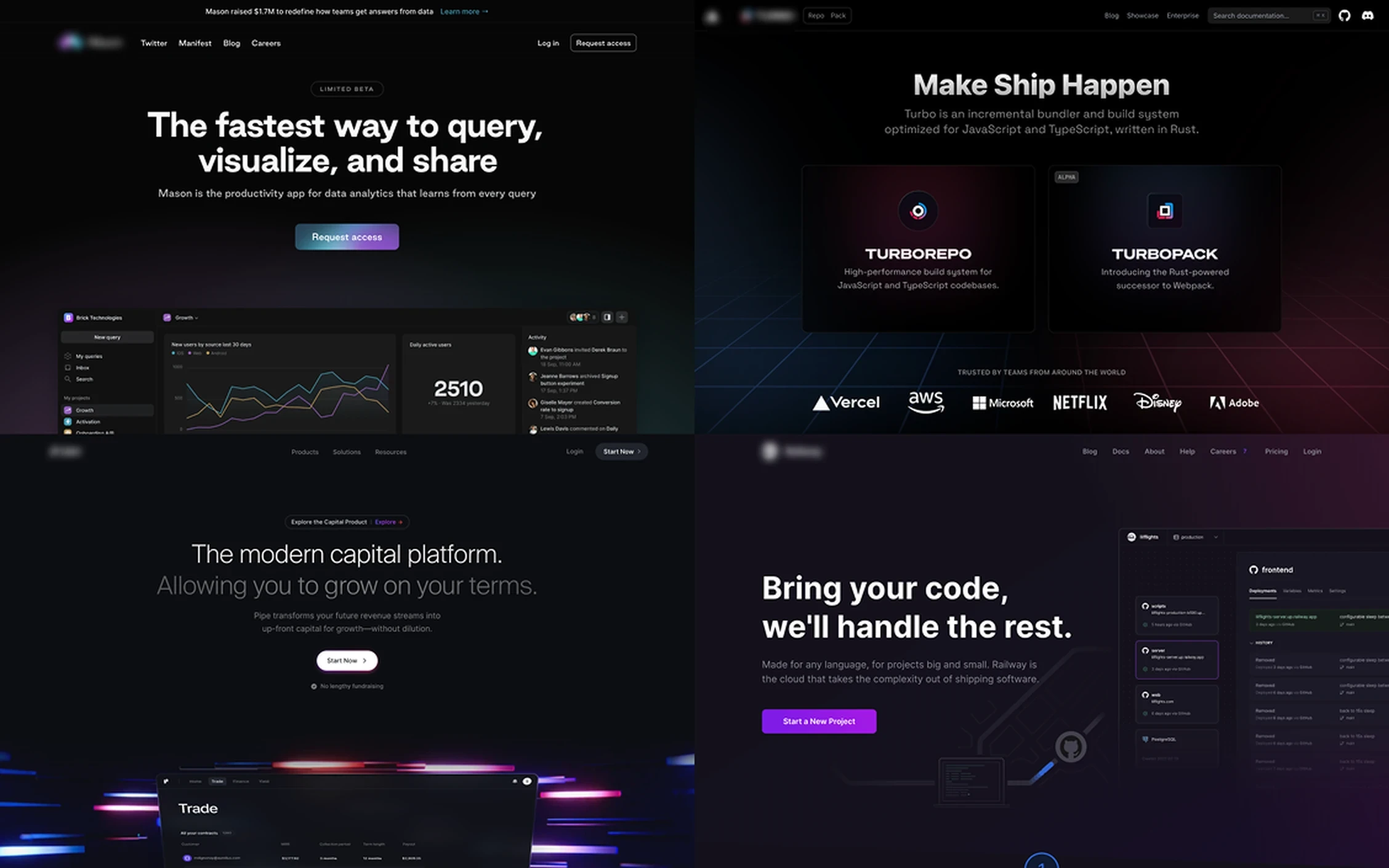
In our competitive audits, we see this constantly. We'll map every player in a category and find the same visual language repeated across eight or ten companies. Same gradients, same illustration style, same layout patterns. Each one individually looks polished. Together, they're invisible — because none of them express anything specific about the company behind them.
A prospect scanning your website next to your competitors' sites can't tell the difference. The visual identity that was supposed to create preference is creating sameness instead.
And here's the thing — the companies being copied? Their brand is working. It creates recognition, preference, and trust. But it works because the aesthetic is an expression of their positioning. When you copy the expression without the positioning, you get the surface without the substance.
It's like hearing a great speaker and copying their gestures. The gestures aren't what made them compelling.
What strategic identity actually looks like
A visual identity that works — that actually earns trust and creates preference — starts with four questions. Not a moodboard. Questions.
What's your product strategy? Linear's was highly opinionated, built for flow. Jira's was flexible, customizable, enterprise control. Both valid — but they require completely different visual identities. If you can't articulate your product strategy clearly, your visual identity has nothing to express.
What emotional space is unclaimed in your category? Linear moved into "serious, calm, precision-focused" when everyone else was trying to be cheerful. In our competitive audits, we specifically look for these gaps — the emotional territory that no player in the category has claimed. That's where your brand has room to be distinctive.
What specific feelings should your product create? Not "delight" — that's vague. Name the actual emotions: clarity, momentum, relief, mastery, confidence. Your visual choices should reinforce those feelings at every touchpoint. When we run customer interviews, the words customers use to describe how the product makes them feel are some of the most valuable inputs for visual identity.
Who are you not for? Your identity gets stronger the moment you draw the line. The companies that try to appeal to everyone end up looking like everyone.
The test
Here's a quick way to evaluate whether your visual identity is actually working: take your homepage, remove the logo, and swap in your closest competitor's name. Does it still make sense?
If the answer is yes — if your visual identity could live on a competitor's site and nobody would blink — it's not expressing your positioning. It's wallpaper.
The goal isn't to copy what winners look like. It's to do what they did — find your unique insight, decide the emotion you want your product to create, and design your visual identity as the clearest expression of both.
That's the difference between a brand that looks like something and a brand that actually means something.